AIUnpacker Review Score
4.8
Features
4.8
Ease
4.4
Value
4.4
Support
What we like
- AI tools are built directly into Canva's familiar editor
- Covers writing, design generation, image editing, video generation, resizing, brand styling, and Canva Code
- Strong for social posts, presentations, marketing assets, classroom materials, and quick campaign visuals
What could be better
- Many advanced AI features are Pro, Teams, Education, Nonprofit, or Enterprise dependent
- AI output still needs brand review and manual polish
- Feature availability can vary by language, country, and account type
The Verdict
"Canva Magic Studio is one of the most practical AI creative suites for non-designers and teams, but its best features, usage limits, and brand controls depend on your Canva plan."
Editorial Disclosure & Testing Notice
This review is published for informational and educational purposes only. It is not a substitute for professional advice. Our scoring is never influenced by compensation; reviews combine product research, public documentation, pricing checks, and hands-on evaluation when access is available.
- For educational purposes only. Scores reflect our editorial opinion at the time of review, not a guarantee of vendor performance.
- Editorial independence. Vendors cannot pay to influence scores. Sponsored reviews and paid placements are always labeled.
- Opinions are our own. Also, we are not affiliated with the companies we review unless explicitly stated.
- Pricing & features change. Always verify on the vendor's site before purchasing.
- Last verified: . Published .
Read more on our About page, Editorial Policy and How We Review.
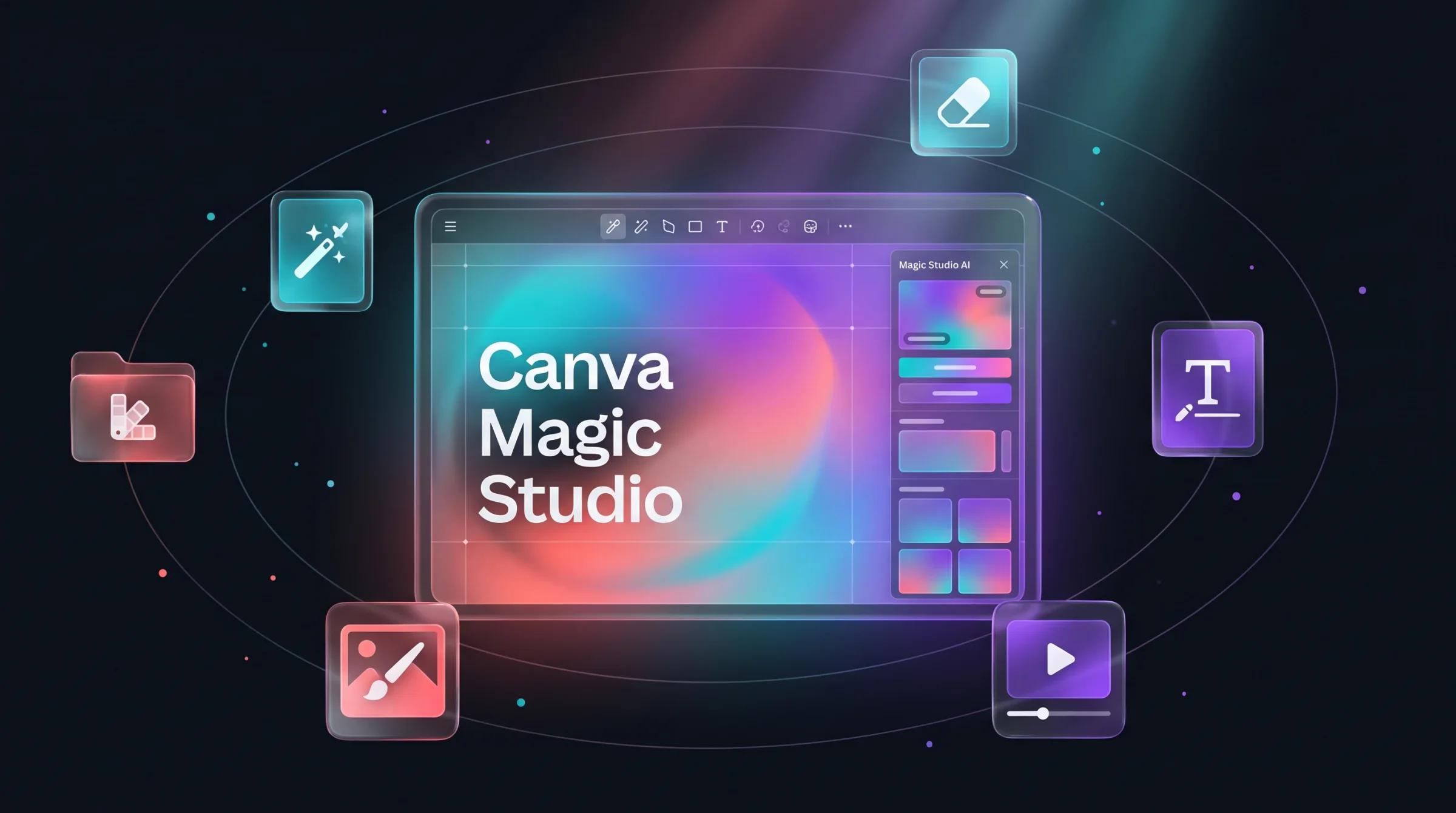
Canva Magic Studio is Canva’s AI layer for writing, design generation, image generation, image editing, video generation, brand styling, resizing, translation, layout conversion, classroom activities, and app-like interactive content through Canva Code. It is not one feature. It is a collection of AI tools placed directly inside Canva’s design workflow.
That placement is the reason Magic Studio matters. Many AI tools create something outside your normal workflow, then force you to copy, download, resize, reformat, and rebuild it somewhere else. Canva puts the AI inside the editor where marketers, teachers, founders, social media managers, internal teams, and non-designers already make assets. That makes it more useful than a standalone image generator for everyday production.
The short version: Canva Magic Studio is one of the strongest AI creative suites for practical business and content work. It is excellent for speed, volume, repurposing, branded templates, social content, presentations, internal comms, classroom materials, simple videos, and first-draft design concepts. It is not a complete replacement for experienced designers, art directors, illustrators, motion designers, brand strategists, or accessibility reviewers.
The honest verdict is that Magic Studio is best when you use it to get to a strong first draft faster, then apply human taste, brand judgment, legal review, and final polish.
What Changed by 2026
The old idea of Magic Studio as “Canva has some AI tools” is outdated. Canva now presents Magic Studio and Canva AI as a broader creative system. Its current Magic Studio page highlights tools for AI-powered design, on-brand design generation, Style Match, 3D Content Generator, Video Generator, Photo Generator, Magic Background, AI-powered photo editing, Resize, Magic Write, Ask @Canva, Magic Activities, Canva Code, AI-powered elements, and app marketplace integrations.
Canva has also started talking about Canva AI 2.0 as a more conversational creative partner: a system where users can describe what they want and Canva can create or adapt designs, writing, brand assets, and code-like interactive outputs. Some features are already available, while others are marked as coming soon or limited by plan, region, or rollout.
The upside is that Canva is becoming a more complete creative operating system for non-designers. The downside is that feature names, plan access, and limits can change quickly. A review has to be careful: not every user gets every AI tool, and free users should not assume they have the same access as Pro, Teams, Education, Nonprofit, or Enterprise accounts.
Who Canva Magic Studio Is Best For
Magic Studio is best for people who need polished creative work without wanting to open five different professional tools.
It is especially strong for:
- Social media managers making posts, stories, reels covers, carousels, and campaign visuals.
- Small businesses creating menus, flyers, presentations, ads, and product graphics.
- Marketers repurposing one campaign into many formats.
- Educators making classroom visuals, activities, worksheets, lesson materials, and presentations.
- Founders creating pitch decks, mockups, launch assets, and quick websites.
- Internal teams creating reports, onboarding docs, training material, and announcement graphics.
- Nonprofits creating fundraising assets and event material.
- Creators producing thumbnails, short videos, visual explainers, and brand kits.
It is less ideal for:
- Brands with strict design systems that require custom art direction.
- Agencies producing high-end original campaigns.
- Designers who need pixel-level control over complex layouts.
- Teams needing advanced motion graphics, print production, or professional photo retouching.
- Regulated industries where every claim and visual implication must be reviewed.
- Anyone who needs guaranteed factual or visual accuracy without human review.
The Core Strength: AI Inside the Editor
Magic Studio’s biggest advantage is workflow. You can start with a blank design, a template, a brand kit, a document, a presentation, a video, or an image, then ask Canva’s AI tools to help inside that context.
That sounds simple, but it matters. A social media manager can generate copy, turn a post into a story format, create a background, remove or adjust an object, match a brand style, and export the result without leaving Canva. A teacher can turn lesson goals into activities. A marketer can turn a webinar deck into social posts and email visuals. A founder can create a launch graphic, a landing-page mockup, and a pitch slide from the same visual system.
For everyday teams, the practical time savings often come from small steps:
- Getting unstuck from a blank page.
- Resizing a design into multiple formats.
- Rewriting copy to match a tone.
- Generating a first visual direction.
- Creating alternate layouts quickly.
- Translating or summarizing existing content.
- Keeping assets closer to the brand kit.
That is more valuable than one flashy AI image.
Magic Write
Magic Write is Canva’s AI writing tool. It can help generate copy, rewrite text, summarize content, brainstorm ideas, create captions, draft presentation text, and adapt tone. According to an OpenAI case study, Canva users have written billions of words with Magic Write, which gives a sense of how deeply the feature has been adopted.
Magic Write is useful because it sits beside the design. You can draft a slide headline, shorten a caption, create a product blurb, or rewrite body copy while looking at the layout. That helps with fit. A paragraph that works in a Google Doc may be too long for a poster or carousel card.
Use it for first drafts, not final facts. Check names, claims, prices, dates, statistics, legal language, and brand tone. For public-facing material, Magic Write should be treated like a junior copy assistant: fast, useful, but not the final authority.
AI-Powered Design and On-Brand Generation
Canva’s AI-powered design tools help create editable designs from prompts or content. On-brand design generation is especially important for teams because it tries to apply brand fonts, colors, and rules so outputs start closer to the company’s visual identity.
This is where Canva beats many generic image tools. A flat generated image may look attractive, but it is hard to edit. Canva’s value is that designs often remain editable: text boxes, layouts, colors, images, and brand elements can be adjusted inside the editor.
For a marketing team, this means AI can produce campaign starting points that still behave like Canva designs. That is more practical than a beautiful but inflexible image.
The limit is originality. On-brand generation can help maintain consistency, but it does not automatically create a distinctive campaign idea. If every team uses similar templates and AI prompts, outputs can become visually samey. The human job is still to choose the concept, sharpen the message, and avoid generic design.
Photo Generator, Magic Background, and AI Photo Editing
Canva’s image tools cover a wide range of everyday needs: generating visuals, creating backgrounds, editing photos, removing or changing elements, and producing images that fit a design context. For social graphics, ads, blog headers, presentations, and classroom material, these tools can be extremely useful.
The best use case is not “make a perfect final image.” It is “create or adjust a visual that supports a communication goal.” Need a background for a workshop slide? A product-style scene for a quick concept? A thumbnail direction? A less cluttered hero image? Magic Studio can speed that up.
Still, image AI needs review. Look for distorted hands, odd text, unrealistic product details, incorrect logos, misleading imagery, biased representation, or visuals that imply something untrue. Canva’s AI tools are convenient, but convenience does not remove responsibility.
Video Generator and Short-Form Creative
Canva’s Video Generator and AI video features are useful for quick clips, social-first motion, simple product explainers, and lightweight campaign assets. This is not After Effects. It is not a full professional video studio. It is better understood as a fast production layer for people who need acceptable video assets without a specialist workflow.
For creators and marketers, that is still valuable. Many teams need basic motion more often than cinematic production. A quick animated announcement, short promo, educational clip, event teaser, or product update can be good enough if it is clear, on-brand, and correctly formatted.
For high-stakes video, review frame accuracy, captions, pacing, brand safety, rights, voiceover, accessibility, and platform requirements.
Canva Code
Canva Code is one of the more interesting additions because it points beyond static design. Canva describes it as a way to create interactive content or data-connected experiences using AI. In practical terms, it can help users make simple interactive elements, mini apps, prototypes, calculators, quizzes, or data-driven design outputs without starting in a traditional development environment.
This is promising for educators, marketers, trainers, and internal teams. Imagine a simple quiz from a slide deck, a lightweight product comparison, a training interaction, or a campaign calculator embedded into a design workflow.
But it should not be confused with full software engineering. Use Canva Code for lightweight interactive assets and prototypes. For production apps, secure workflows, database-backed tools, complex logic, or anything involving sensitive data, a proper development process is still necessary.
Magic Layers and Reliability Caveat
Canva’s AI roadmap includes more editable AI design workflows, including Magic Layers, which can turn flat images into editable layered designs. That is a big deal because one of the biggest frustrations with AI visuals is the inability to adjust individual parts cleanly.
There is also a reason to be cautious. In April 2026, Canva apologized after reports that an AI editing tool altered the word “Palestine” in a design. The issue was reported as fixed, but it is a useful reminder: AI editing tools can behave unexpectedly, especially when interpreting text or layered content.
The lesson is not “avoid Canva.” The lesson is “review AI-edited assets before publishing.” If AI changes a visible word, swaps an element, or misreads a sensitive context, the user is still responsible for catching it before the design goes public.
Canva Shield, AI Privacy, and Enterprise Controls
Canva Shield is Canva’s trust, safety, privacy, and enterprise-control framework for AI use. Canva’s current Shield materials describe trust and safety systems, user privacy controls, a creator commitment, and indemnification for eligible enterprise customers using Magic Studio products.
Canva says users can control whether private content is used to train AI, and its Magic Studio page says Canva does not use Enterprise data to improve AI-powered features, with that setting not available to be turned on by Enterprise users or admins. It also describes admin controls for team access to Canva AI products.
For larger teams, these details matter. AI adoption is not only about features. It is about who can use which tools, what data can be uploaded, whether private content can train models, whether outputs are covered by indemnity, and how admins manage risk.
Enterprise buyers should still read the actual terms, data processing documents, and policy pages. Canva’s AI Product Terms, effective March 16, 2026, include rules against harmful uses and against misleading people that AI-generated content is human-generated. They also prohibit removing or disabling provenance or metadata tags from AI-generated content, including C2PA metadata.
Pricing and Access
Canva’s AI access depends on your plan. Canva’s current Magic Studio page says some features are available to free accounts, while premium AI tools and higher usage limits depend on plan. It points users to pricing and usage-limit pages for the current details.
In practice, this means:
- Free users can try some Canva AI features, but with lower access and limits.
- Canva Pro users get broader access, higher limits, and tools such as Brand Kit and premium assets.
- Canva Teams adds collaboration and team features.
- Canva for Education and Canva for Nonprofits may include access for eligible users.
- Canva Enterprise adds admin controls, security, governance, and eligible AI indemnification.
The exact limits can change, so check the live Canva pricing and AI usage pages before buying a plan for one specific AI feature.
Output Quality
Magic Studio output is usually good enough for first drafts, internal assets, social content, classroom materials, and rapid campaign production. It is often surprisingly polished because Canva’s templates, asset library, and editor are already strong.
The weakness is sameness. If you rely only on AI defaults, your work can look like everyone else’s. The best users bring a point of view: a clear brief, a brand kit, examples, constraints, and a willingness to edit.
Quality review should include:
- Does the design fit the brand?
- Is the copy accurate?
- Is the layout readable on mobile?
- Are contrast and accessibility acceptable?
- Does the image imply something false?
- Are logos, product details, and names correct?
- Is the design too generic?
- Does the asset need rights or legal review?
Best Workflows
For marketers, the best workflow is campaign repurposing. Start with one campaign idea, then use Canva to create a presentation slide, social post, story, ad variation, email header, and short video. Magic Studio helps resize, rewrite, and restyle the idea quickly.
For educators, the best workflow is lesson-to-material. Start with learning objectives, then create a slide deck, worksheet, quiz, activity, and visual summary. Magic Activities and Magic Write can help draft, while the teacher reviews accuracy and age fit.
For small businesses, the best workflow is launch-in-a-box. Create a flyer, menu, product card, Instagram post, promotional video, and simple website visual from the same brand kit.
For teams, the best workflow is controlled self-service. Designers create brand kits and templates; non-designers use Magic Studio within those boundaries; the final assets go through review when needed.
Alternatives
Adobe Express and Adobe Firefly are strong alternatives for teams already in Adobe’s ecosystem or those needing more advanced generative image control.
Figma is better for product design, interface systems, collaborative design files, and professional design workflows.
Microsoft Designer is useful for Microsoft-centric users who need quick graphics tied to productivity tools.
Midjourney and other image generators can create more visually distinctive standalone images, but they do not replace Canva’s editable design workflow.
Beautiful.ai, Gamma, and Tome-style tools may be better for AI-assisted presentation generation, depending on your needs.
Canva’s advantage is breadth and usability. It may not be the deepest tool in every category, but it covers more everyday creative jobs in one place than almost any competitor.
Final Verdict
Canva Magic Studio is worth it for marketers, educators, creators, founders, small businesses, and teams that need fast, polished, reusable visual content. It is one of the most practical AI creative suites because it is built into a tool people already know how to use.
It is not a replacement for senior design judgment. The best results still require a clear brief, brand standards, human editing, accessibility review, and factual checking. AI can get you to the first draft faster; it cannot decide what your brand should stand for.
My rating is 4.7 out of 5. Magic Studio earns that score because the feature breadth, ease of use, and workflow integration are excellent. The main limits are plan-dependent access, changing usage caps, occasional AI reliability issues, and the need for human review on public or sensitive assets.
Reference Sources
Ready to try Canva Magic Studio?
Start using it today and see the difference for yourself.
Weekly digest
Don't buy blind.
Weekly AI tool reviews and benchmarks delivered to your inbox.
No spam. Unsubscribe anytime.

AIUnpacker Editorial Team
Verified ReviewerA collective of engineers, journalists, and AI practitioners dedicated to providing hands-on, transparently disclosed analysis.